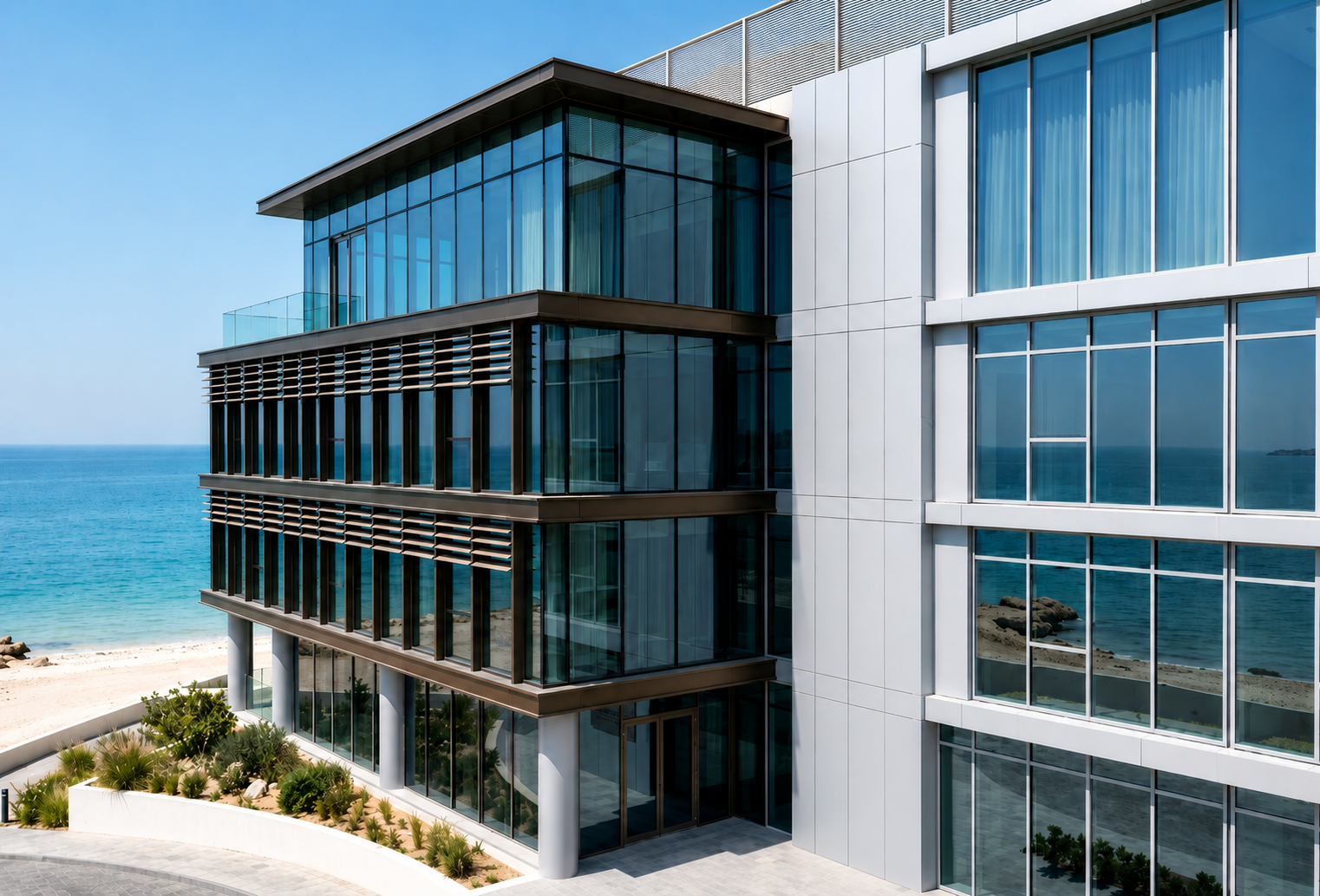
The Gulf coastline — stretching from Jeddah on the Red Sea to Dammam and Al Khobar on the Arabian Gulf — presents one of the most corrosive exterior environments for architectural aluminum. High chloride ion concentrations from sea spray, combined with extreme UV radiation, elevated temperature, and humidity, can cause premature surface degradation, pitting corrosion, and structural weakening in inferior systems within just 3 to 5 years of installation.
Alloy Selection: The Foundation of Durability
6063-T5 vs. 6060-T6 for Coastal Applications
The two most common architectural aluminum alloy series for extrusion profiles are 6060 and 6063. Both offer excellent natural corrosion resistance due to the stable, self-regenerating aluminum oxide layer that forms on the surface. For coastal Gulf applications, 6063-T5 with a minimum anodising thickness of 25 microns (Class AA25 per EN ISO 7599) is the recommended specification. This thickness provides a robust, hard barrier layer against chloride ingress, far exceeding the standard 15-micron specification used in inland applications.
Powder Coating Specifications for Coastal Durability
Powder coating is the preferred surface finish for architectural aluminum profiles combining aesthetics and protection. For coastal Gulf installations, the minimum powder coat specification is 60–80 microns dry film thickness (DFT) of a TGIC-free polyester powder conforming to QUALICOAT Class 2 certification. Class 2 coatings are tested to a minimum of 1,000 hours of neutral salt spray (NSS) per EN ISO 9227, and 2,000 hours of QUV accelerated weathering, confirming long-term retention of colour, gloss, and adhesion under harsh coastal conditions.