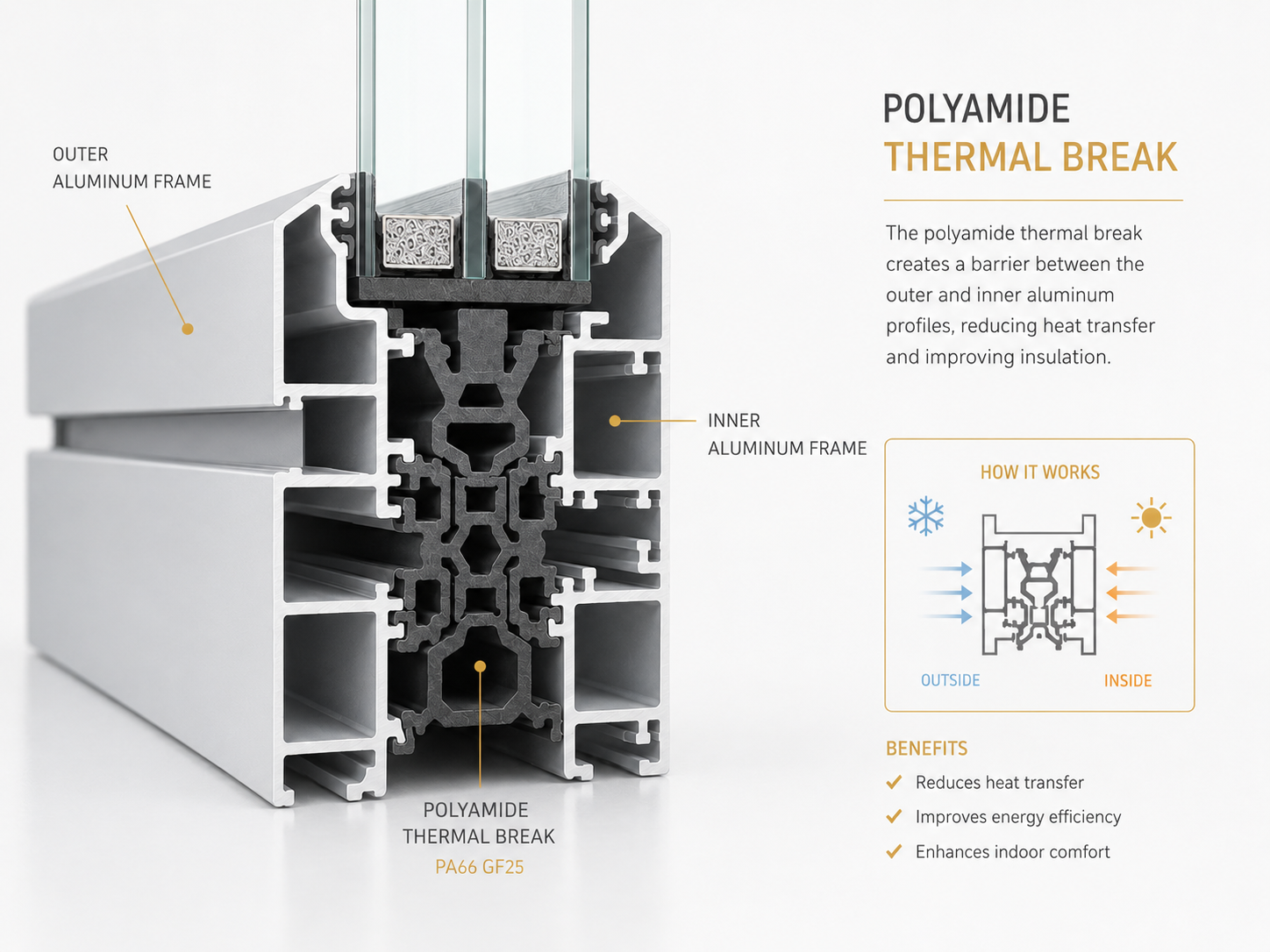
Aluminium is one of the most thermally conductive structural metals in common use, with a thermal conductivity (λ) of approximately 160 W/(m·K). In temperate climates this creates manageable heat-bridge problems. In the Gulf environment, where ambient summer temperatures routinely exceed 50 °C and surface temperatures on south-west facing metal profiles can reach 80 °C, an untreated aluminium frame becomes a direct conduit for solar heat gain into conditioned space. The solution lies in a deceptively simple component: the polyamide thermal break.
What Is a Polyamide Thermal Break?
The Physics of Interrupted Conductivity
A thermal break is a continuous strip of low-conductivity material placed between internal and external aluminum frames to interrupt thermal transfer. Polyamide 6.6 reinforced with 25% glass fiber (PA66 GF25) is the industry standard, offering a thermal conductivity of roughly 0.3 W/(m·K), which is over 500 times lower than aluminium. By placing this barrier in the center of the frame, heat flow is effectively stopped.
Why SHGC Dominates in Saudi Climate Conditions
Saudi Arabia's climate is characterised by very high solar irradiance — horizontal global irradiance at Riyadh regularly exceeds 900 W/m² — combined with extremely hot summers and mild winters. The cooling season spans approximately eight months of the year in most Saudi climate zones. The heating season, where U-value becomes relevant to energy consumption, is limited to December and January in the coldest inland areas and is negligible in coastal zones. Energy simulation studies consistently show that in Saudi Arabia, reducing SHGC from 0.40 to 0.25 produces a far greater reduction in annual HVAC energy consumption than reducing U-value from 2.0 to 1.5 W/(m²·K). For a typical commercial office building in Riyadh with 40% WWR, the SHGC improvement delivers approximately 15–22% annual cooling energy reduction; the equivalent U-value improvement delivers less than 4%.
The Light-to-Solar Gain Ratio: Your Primary Specification Tool
Balancing Daylight and Heat Gain
The Light-to-Solar Gain ratio (LSG = Visible Light Transmission ÷ SHGC) is the most useful single metric for comparing glazing products in Gulf applications. A high LSG means the glass allows more daylight per unit of solar heat admitted. For Gulf environments, specifying a high-performance double-glazed or triple-glazed unit with a selective low-emissivity coating on surface #2, coupled with a polyamide thermal break system, is key to meeting the Saudi Building Code (SBC 601) and ensuring long-term thermal compliance and cooling savings.